Sweep Them Off, Sell Them to Tourists: Ghana's Street Hawking Contradiction
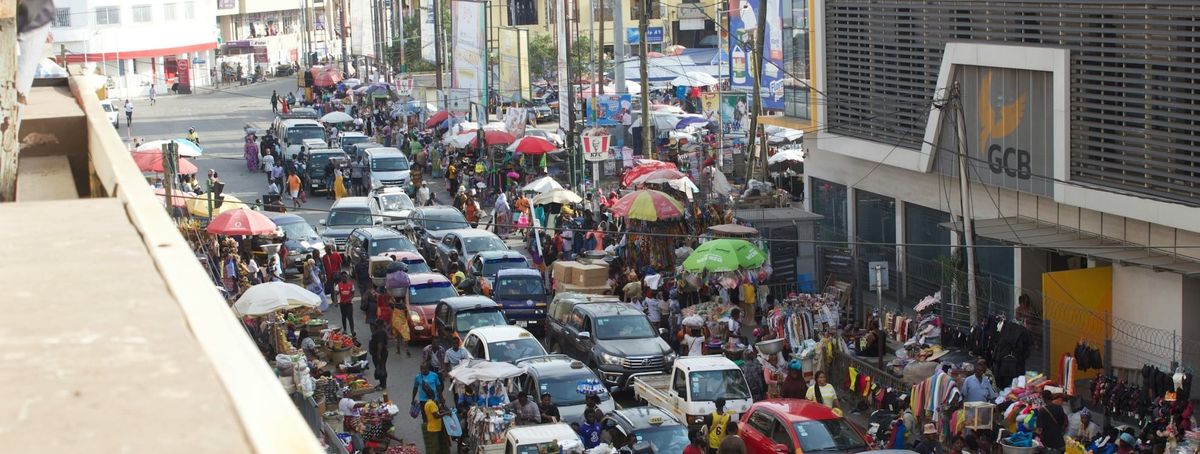
At 4 a.m. on a Tuesday in May, Accra Metropolitan Assembly task force officers moved through Kinbu Street, Makola and Kantamanto, clearing traders from the pavements. Wares were confiscated. Pavements were repainted with red “no go” markings. The Mayor described the exercise as necessary and promised a cleaner and more secure capital.
Walk a short distance from those streets, or spend a few minutes scrolling through Tripadvisor, and you will find a very different description of the same places.
Tour operators advertise visits to these markets as authentic Ghanaian experiences. Kantamanto is presented to visitors as one of Accra's most interesting destinations, a place where they can witness local entrepreneurship, resilience and everyday life. In Kumasi, Kejetia is promoted as a must visit destination for anyone looking for an authentic Ghanaian experience.
The noise, the crowds, the bargaining and the sheer unpredictability of these markets are part of what makes them attractive to tourists. And that is where the contradiction becomes difficult to ignore. The same informality that city authorities want to remove is also being packaged and sold as part of Ghana's cultural identity. Nobody in city government appears to have fully reconciled these two positions. Perhaps they do not have to. For now, both approaches simply continue side by side.
A Cycle That Never Really Ends
This is not a new problem, and after decades of repeated interventions, it is difficult to argue that the current approach is working.
Virtually every administration since the beginning of Ghana's Fourth Republic has identified street hawking as a problem requiring a decongestion exercise. The pattern is remarkably familiar. Streets are cleared, order returns for a while, and then, gradually, traders come back.
The latest version began in May 2025, when Accra's newly appointed mayor, Michael Kpakpo Allotey, launched a joint operation with the Korle Klottey Municipal Assembly to clear parts of the Central Business District. Officials stressed that this would be a sustained operation rather than another short lived exercise.
Yet within days, reports from the area showed traders returning to the same streets. Some were even selling on pavements marked with the red paint intended to keep them away. This is important because it shows that the problem is not simply a lack of enforcement.
Ghana has also tried a more structural approach by relocating traders into purpose built markets rather than simply removing them from the streets. Research on Accra's Odawna Pedestrian Market, which was built partly to accommodate displaced hawkers, found that relocation did move a significant number of traders away from the streets. However, many continued operating from the pavements, while those who relocated experienced reductions in income.
That tells us something that repeated decongestion exercises often overlook. Moving people away from the street is not the same thing as removing the economic conditions that brought them there.
Why the Problem Keeps Coming Back
The persistence of street hawking is not simply about stubborn traders refusing to obey the law. It is also about economics. Ghana's informal sector employs an estimated 80 percent of the national workforce, according to the Ghana Statistical Service's recent productivity data, while accounting for a much smaller share of formal economic output. Across Africa, the informal sector also represents a huge part of employment and economic activity.
Put simply, millions of people depend on informal work. That makes the idea of completely eliminating street trading extremely difficult.
A decongestion exercise can clear a pavement. It cannot create thousands of formal jobs overnight. It cannot suddenly make shop rents affordable. It cannot provide every trader with a permanent place to sell. So the pavement gets cleared, but the reason someone was standing there selling phone credit, food, clothing or household items remains. This is why the same exercise can happen again and again without solving the problem. The authorities are dealing with the visible part of a much larger economic problem.
This Fight Is Much Older Than Today's Task Forces
The early morning task force sweep is not a new tactic. Ghana has been having versions of this argument for decades.
In 1979, for example, market women were blamed for aspects of the country's economic difficulties under the military government of the time. The campaign against traders became violent, with traders being beaten and killed, while Makola Market itself was demolished.
In the 1990s, by laws were used to prohibit unlicensed street trading, with efforts made to relocate hawkers away from central business areas.
The 2000s brought another round of attempts to decongest Accra, including efforts to clear parts of the Central Business District and evict residents from Old Fadama. Research has shown how political interference and poorly implemented relocation arrangements undermined some of these efforts.
The details have changed over the years, but the basic story remains remarkably similar. A new administration arrives. A new mayor makes a promise. Traders are cleared. Streets become quieter for a while. Then the traders return.
There is a reason for this. Scholars studying informal urban life have described this kind of behavior using the concept of “quiet encroachment,” a term associated with Iranian sociologist Asef Bayat. The idea describes how ordinary people gradually occupy or make use of spaces controlled by more powerful institutions, not necessarily as an organized political protest, but because they need somewhere to live and work.
That description fits much of what happens on Accra's streets. For many traders, the choice is not between a pavement and a comfortable formal shop. It is between selling wherever they can and having no income at all. One hawker interviewed in earlier research explained the situation in simple terms. It was not that he preferred selling on the street. He was there because he had little else to do.
That is the part of the conversation that often gets lost. When people are repeatedly pushed out of the spaces where they make a living, they eventually organize. Informal traders' associations, including the Informal Hawkers and Vendors Association of Ghana, have brought traders together to negotiate with city authorities rather than simply disappear whenever an enforcement operation begins.
That changes the way the issue should be understood. This is not simply a battle between an orderly government and a disorderly population. It is a decades long negotiation over who has the right to use some of the most valuable public spaces in Ghana's cities.
Nuisance, or Just Misunderstood?
There is another part of this debate that deserves more attention. Street hawkers are often discussed as though they are evidence of social failure. The assumption can be that people hawk because they lack the education, discipline or ambition to do something else. Research on Ghanaian street hawkers challenges that view.
Many traders understand perfectly well how society sees them. They have developed their own coping mechanisms, relationships and networks, often across ethnic and community lines. For them, street trading is not necessarily a meaningless or degrading activity. It is work. There is an older sociological argument that helps explain this. The situational constraints perspective suggests that poverty and limited opportunities can constrain people's choices. If those constraints disappear, many people would willingly take advantage of more secure and conventional employment.
In other words, the question should not always be, “Why are these people choosing to hawk?”
A better question might be, “What choices do they actually have?”
This question complicates both of the dominant ways we talk about street traders. ne narrative describes them as a public nuisance that needs to be removed. The other describes them as colorful evidence of an authentic African experience that tourists should come and see. Neither description really treats them as ordinary people making rational decisions within difficult circumstances.
One wants them gone. The other wants them photographed. Very few people ask what they themselves would prefer.
When “Authentic Ghana” Becomes a Tourism Product
This is where the contradiction becomes even more uncomfortable. Think about what makes a visit to Kantamanto or Kejetia interesting to a tourist. It is not simply the buildings. It is the people. The bargaining. The noise. The movement. The piles of goods. The crowded walkways. The conversations between buyers and sellers. The feeling that something is always happening.
Those are precisely the characteristics that often make these markets difficult for city authorities to manage. Yet those same characteristics can be marketed to tourists as authentic Ghanaian culture. That is not necessarily wrong. Markets are genuinely important parts of Ghanaian social and economic life, and visitors should be able to experience them. But there is a question that deserves to be asked. Who benefits from selling that experience?
A tourist may pay a tour operator to walk through Kantamanto. A hotel may advertise market tours to international guests. A guide may earn money from bringing visitors into the area. Meanwhile, the trader whose everyday work makes the experience possible remains exposed to confiscation, eviction and harassment.
The irony is hard to miss. The state can treat informal trading as a public order problem in the morning while the tourism economy treats the same informal environment as a cultural attraction later in the day. The same hawker can therefore be viewed in two completely different ways. To the task force, the hawker may be an obstruction. To the tour guide, the same person may be part of the “authentic Ghanaian experience.” But to the hawker, he or she is simply trying to make a living.
What Would an Honest Policy Look Like?
None of this means decongestion is inherently wrong. Pavements need to be accessible. Pedestrians need somewhere safe to walk. Selling directly beside moving traffic can be dangerous. Cities have legitimate responsibilities when it comes to sanitation, traffic management and public safety.
The problem is what happens when enforcement becomes the entire policy. An honest approach would begin by acknowledging what street trading actually represents. It is not simply a temporary nuisance that can be swept away. It is part of the economic reality of millions of Ghanaians. That means the answer has to go beyond sending task force officers into the streets. Cities need designated trading spaces that are genuinely accessible and economically viable. Relocation programs need to consider whether traders can actually make enough money in the new locations to survive. Formalization should not simply create new fees and regulations that push vulnerable traders further out of the system.
And if Ghana is going to market its markets as tourist attractions, the people who create that experience should not be completely excluded from the value it generates. There could be better links between tourism operators, market associations and local authorities. Traders could be included in tourism planning. Market based tourism could create direct opportunities for the people whose work makes these places worth visiting in the first place. Until that happens, Accra will probably continue running two contradictory scripts. At dawn, task force officers will clear the pavement.
By mid-morning, tourists may be walking through the same market with a guide, taking photographs and being told that what they are seeing is the authentic Ghana. The uncomfortable truth is that both sides are looking at the same people.
The difference is simply what they choose to see
Comments ()